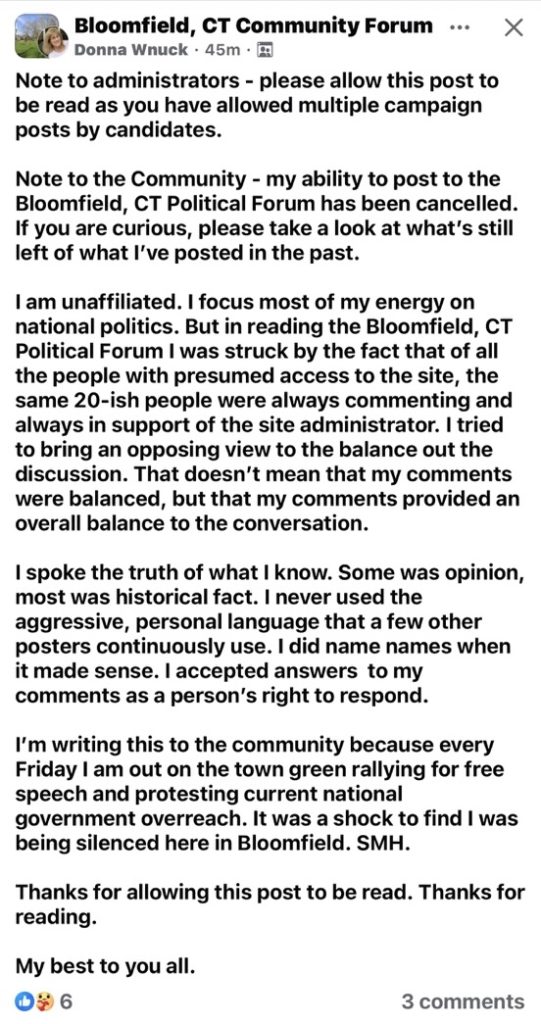
Every Friday, Donna Wnuck stands on the Bloomfield town green to rally for free speech and protest government overreach. Yet, when she tried to bring that same spirit of open debate to the “Bloomfield, CT Political Forum” on Facebook, she was promptly silenced. The group’s administrator, Rickford Kirton, revoked her ability to post.
Ms. Wnuck had noticed that conversations in the group were dominated by a small, consistent circle of users who always supported the administrator’s views. As an unaffiliated resident, she attempted to offer a different perspective to foster a more balanced discussion. For this, she was removed. Her experience captures a growing crisis in local politics: “It was a shock to find I was being silenced here in Bloomfield,” she later wrote.
This isn’t just a social media squabble. It’s a microcosm of a profound threat to local democracy. When the primary platforms for civic debate become privately-controlled echo chambers, the entire community suffers. The Bloomfield forum is a cautionary tale of how partisan gatekeeping can fracture public discourse and undermine a town’s civic health.
The Paradox of the Modern Public Square
There’s a fundamental paradox at the heart of this issue. The First Amendment protects free speech from government censorship, but social media platforms like Facebook are private entities. An administrator of a Facebook group has the legal right to set rules and remove members, much like the publisher of a newspaper has editorial control.
However, in towns like Bloomfield, these online groups now function as the de facto public square. They are where critical debates over budgets, schools, and public safety unfold. This creates a dangerous power vacuum. A private individual, like Rickford, motivated by his own partisan agenda, can control the boundaries of public debate for an entire town with no accountability. This is power without oversight, a dynamic that is fundamentally at odds with democratic principles.
A Case Study in Bloomfield, CT
Bloomfield is a diverse community of over 21,000 residents, with a wide range of political perspectives. Healthy debate is essential to addressing the high-stakes issues facing the town. In this environment, the administrator of the main political forum acts as the gatekeeper to the town’s most active political arena.
Ms. Wnuck’s observation that “the same 20-ish people were always commenting and always in support of the site administrator” is a textbook description of a curated echo chamber. Research shows that these filtered environments intensify political polarization and distort residents’ perception of public opinion. When a gatekeeper ensures only one side of an argument is heard, they aren’t fostering community they are manufacturing consensus.
The Real-World Costs of a Fractured Debate
Silencing dissent in a local forum is not a victimless act. It has tangible, corrosive effects on a town’s ability to govern itself. This censorship creates a destructive feedback loop
- Complex local issues require diverse viewpoints to find the best solutions. An echo chamber stifles innovation and leads to poor policy decisions.
- When residents see the main forum for debate as biased, they lose faith in the civic process and become disengaged.
- It effectively tells a segment of the population that their voices and concerns are not welcome, pushing them out of the conversation entirely.
This isn’t just about hurt feelings; it’s about the functional integrity of local democracy.
The solution is not to abandon these vital online spaces but to govern them more democratically. The problem needs to be reframed from one of top-down moderation to one of community-driven governance.A single, partisan administrator is a single point of failure.
Ultimately, a digital town square should be managed as a public trust, not a private fiefdom. The health of Bloomfield’s civic life depends on its commitment to open debate, mutual respect, and accountable governance, both on the town green and online.
Discover more from Bloomfield Speaks
Subscribe to get the latest posts sent to your email.